Local Peacebuilding in Nepal after the Peace Accord
 AI
AIThe Nepal peace process is usually narrated from Kathmandu: the Comprehensive Peace Accord of November 2006, the arrival of United Nations arms monitors, the election that made a rebel movement the largest party in a constituent assembly. Told that way, it reads as a sequence of elite bargains. The view from the districts where the war was fought is less tidy, and more instructive about why the settlement held.
The Maoist insurgency ran from February 1996 until the 2006 ceasefire. Counts of the dead range from roughly 13,000, the figure long used by the Uppsala Conflict Data Program, to around 17,000 in later official tallies, and monitors such as the Informal Sector Service Centre recorded more than 1,300 enforced disappearances on top of that. Behind the aggregate numbers sat realities national negotiations barely touched: displaced families, contested land, police posts abandoned for years, and local administration defunct outside district headquarters.
This article looks at the machinery Nepal built below the national level, principally the local peace committees, and at two districts that tested it: Rukum, the hill heartland of the insurgency, and Bara, on the Tarai plain, where the post-war years brought new violence.
The Nepal peace process after the 2006 accord
The Comprehensive Peace Accord, signed on 21 November 2006 by the Government of Nepal and the Communist Party of Nepal (Maoist), formally ended the armed conflict. It committed the parties to cantonment of the Maoist People’s Liberation Army, barracks confinement of the Nepal Army, constituent assembly elections, and mechanisms for truth-seeking and victim relief. The United Nations Mission in Nepal, established by the Security Council in January 2007, monitored the arms provisions; its verification registered just over 19,000 Maoist combatants in seven main cantonment sites and disqualified around 4,000 as minors or late recruits.
UNMIN was a deliberately light mission by the standards of the United Nations peacebuilding architecture: no peacekeeping troops, no executive mandate, just monitoring and electoral assistance. The heavier questions, integration of combatants, state restructuring, justice for wartime abuses, were left to Nepali politics. That kept the process nationally owned; it also meant progress stalled whenever coalition arithmetic in Kathmandu did.
Integration was the longest impasse. The parties agreed terms only in 2011, and by the time the cantonments closed in 2012 fewer than 1,500 former combatants had entered the Nepal Army, according to International Crisis Group reporting; most took voluntary retirement packages. The delay had a local cost: for six years, districts hosting cantonments lived alongside a parallel armed force whose future nobody could state.
Local peace committees and the ministry that ran them
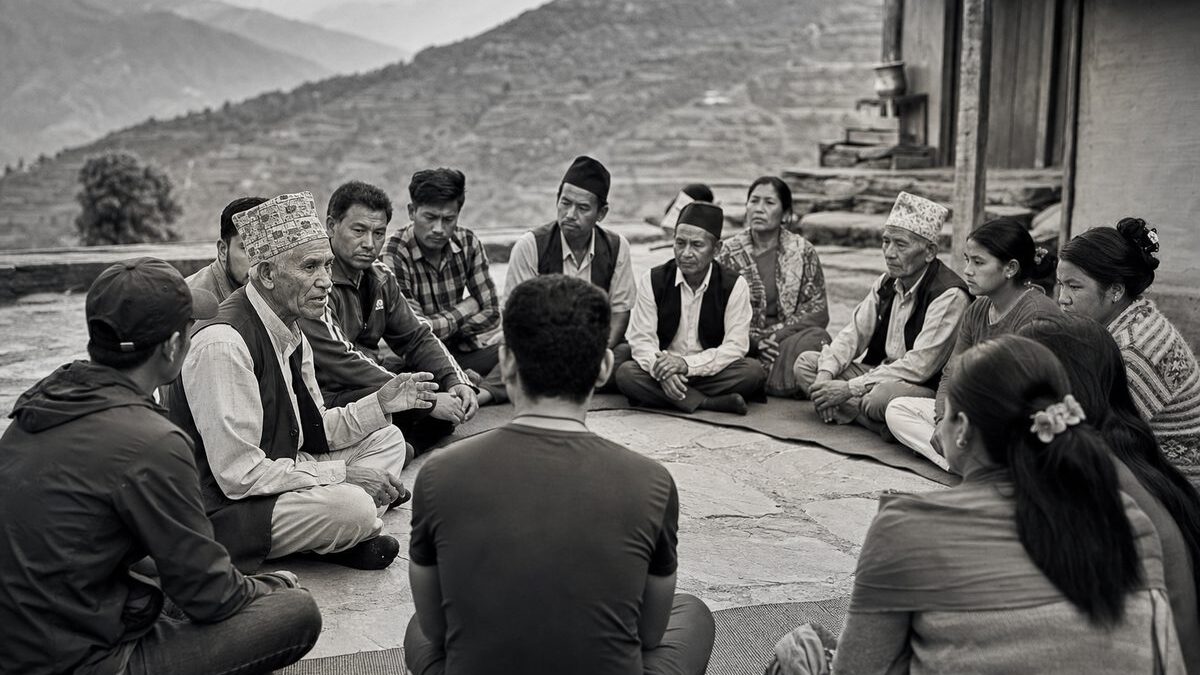
Nepal’s instrument for the district level was the local peace committee. From 2007 the new Ministry of Peace and Reconstruction established LPCs, multi-party bodies seating civil society members, women’s representatives, and conflict victims. Terms of reference revised in 2009 gave them a defined brief: local implementation of the accord, verification of victim relief claims, mediation of conflict-related disputes, and early warning of renewed tension. Surveys by The Asia Foundation found committees eventually formed in nearly all of Nepal’s 75 districts.
Their record was uneven. Some committees became sites of party patronage, mirroring the coalition quarrels that slowed the national process. Where district party leaders wanted a dispute settled, the LPC gave them a table; where they did not, it met rarely and decided little.
Studies of the committees, including The Asia Foundation’s multi-year assessments, reached a consistent conclusion: local peace committees in Nepal worked best as facilitation forums, moving relief claims and defusing specific disputes, and worst as decision-making bodies, where party representatives reproduced national deadlock in miniature.
Even that qualified record mattered. Verifying tens of thousands of relief claims required a body that could say, district by district, who had been killed, displaced or disappeared, and the committees did much of that work. Their practice also echoed a wider lesson from comparative work on mediation and structured dialogue: a standing forum parties already know how to convene is worth more in a crisis than one assembled after violence starts.
Rukum: peacebuilding in the wartime heartland
Rukum, in the mid-western hills, was where the war began and where its social imprint ran deepest. The Maoist “people’s war” opened in February 1996 with attacks on police posts in Rukum and neighbouring Rolpa, and both districts remained base areas throughout the conflict. State presence contracted to district headquarters; the Maoists ran their own courts and administrations across much of the countryside.
Recovery in Rukum was therefore less about reconciling two communities than about re-establishing a state many residents had not dealt with for a decade, without treating the population as defeated. Police posts had to be restored in villages where police were remembered chiefly for wartime operations. Land seized during the conflict had to be returned or settled, an accord commitment implemented slowly and unevenly. Former combatants returned home in numbers, since the district had supplied so many, and their reintegration was as much a village matter as a cantonment one.
The 2015 constitution then redrew the local map: the district was split into Eastern and Western Rukum, and elected local governments assumed many functions the peace-era committees and district officers had held. Where the war’s legacy is handled today, it is largely by these municipal bodies, which is what durable links between peace and development look like once a process matures: ordinary institutions absorbing what special-purpose ones began.
Bara and the Tarai: a harder test
Bara district, on the southern plain, tested the settlement differently. The Tarai’s grievances, under-representation of Madhesi communities in the state, citizenship and language questions, predated the Maoist war and outlasted the accord. In 2007, the first year of peace, the plains saw sustained protest and new armed splinter groups. The worst episode came on 27 March 2007 at Gaur, Bara’s district headquarters, where clashes between Maoist cadres and supporters of the Madhesi People’s Rights Forum left 27 people dead, a toll documented by the UN human rights office in Nepal. Human Rights Watch reporting from the period records how quickly public security deteriorated across the eastern and central Tarai.
Gaur exposed the limits of a peace process framed around one conflict dyad. The accord had been negotiated between the state and the Maoists; it had little to say about inter-party violence on the plains, and authorities in places like Bara faced armed groups, strikes and abductions with thin police coverage and weak intelligence. Local peace committees existed there too, but a body built to verify conflict-victim claims could not manage an active security crisis. What residents needed first was basic public security and functioning justice institutions, and those took years longer to arrive on the plains than in the hills.
Security, justice and the unfinished agenda
Research during the peace years pointed at exactly this gap. International Alert, which studied perceptions and provision of security in Nepal in the late 2000s, convened donors, EU member state representatives and Nepali civil society in Kathmandu to discuss its findings.
The discussion recorded a pointed observation: attention had fixed on integrating Maoist combatants into the state army, while public security and security sector reform at local and regional levels went largely undebated. Participants also flagged that young people were both affected by and drawn into public insecurity, and that youth groups could carry much of the long-term work.
The justice half of the agenda moved slower still. The Truth and Reconciliation Commission and the Commission of Investigation on Enforced Disappeared Persons were established only in 2015, nine years after the accord, and the TRC’s own registry took in more than 60,000 complaints that remain substantially unresolved. Amnesty provisions in the founding law were struck down by Nepal’s Supreme Court, and amended legislation adopted in 2024 restarted the commissions. The district connection is direct: unresolved wartime cases sit in the same communities the committees once mapped, which is why practitioners treat transitional justice and security sector reform as one linked field.
Set against comparable settlements, Nepal’s local record still reads as a qualified success. The war did not resume. Combatants disarmed and dispersed without organised violence. A constitution, whatever its contested provisions on the Tarai, moved real budgets and authority to 753 elected local governments. The committees were dissolved with the Ministry of Peace and Reconstruction, whose functions were folded into the home ministry in 2018, but the habits they rehearsed, cross-party tables, victim registries, district-level dispute handling, migrated into the new municipal structures. For anyone weighing what centrally designed local infrastructure can and cannot do, Nepal remains one of the more instructive cases in the analysis literature on post-war recovery.
Frequently asked questions
What was the Nepal peace process?
The negotiated settlement that ended the Maoist insurgency of 1996 to 2006, centred on the Comprehensive Peace Accord of 21 November 2006. It included UN-monitored cantonment of combatants, the 2008 constituent assembly election, abolition of the monarchy, integration or retirement of former fighters by 2012, and the 2015 federal constitution.
What were local peace committees in Nepal?
District-level bodies established from 2007 by the Ministry of Peace and Reconstruction, seating party representatives alongside civil society members, women’s representatives and conflict victims. Their brief covered local implementation of the accord, verification of victim relief claims, mediation of conflict-related disputes and early warning. Asia Foundation surveys found them in nearly all of Nepal’s 75 districts.
Did the local peace committees work?
The record is mixed. The Asia Foundation’s multi-year studies found them effective as facilitation forums, processing victim relief claims and defusing local disputes, but weak as decision-making bodies, where party representatives reproduced national deadlock and some committees became patronage vehicles. Performance varied sharply from district to district.
What happened to the Maoist combatants after the war?
UNMIN verified just over 19,000 combatants in cantonments and disqualified around 4,000 as minors or late recruits. Under the deal reached in 2011, each verified combatant chose integration into the Nepal Army, voluntary retirement, or rehabilitation support. International Crisis Group reporting records that fewer than 1,500 joined the army when the cantonments closed in 2012.
Why is Rukum significant in Nepal’s conflict history?
Rukum, with neighbouring Rolpa, was where the Maoist “people’s war” began in February 1996 and remained a base area throughout the conflict, with state administration confined to district headquarters while the Maoists ran parallel courts and local government. Under the 2015 federal restructuring the district was divided into Eastern and Western Rukum.
What happened in Gaur, Bara district, in 2007?
On 27 March 2007, clashes in Gaur between Maoist cadres and supporters of the Madhesi People’s Rights Forum left 27 people dead, killings documented by the UN human rights office in Nepal. The episode symbolised the wider Tarai crisis of 2007 and showed that the accord’s framework did not address inter-party and identity-based violence.
How did the 2015 constitution change local peacebuilding?
It created a federal state with seven provinces and 753 elected local governments holding significant budgets and powers. The Ministry of Peace and Reconstruction was wound up and its functions moved into the home ministry in 2018, dissolving the local peace committees. Madhesi parties in the Tarai protested the provincial boundary and representation provisions.
Has transitional justice in Nepal been completed?
No. The Truth and Reconciliation Commission and the disappearances commission were established only in 2015, and the TRC registry took in more than 60,000 complaints that remain substantially unresolved. Nepal’s Supreme Court struck down amnesty provisions, amended legislation passed in 2024 restarted the process, and victims’ groups continue to press for prosecutions and reparations.
Why did Nepal’s settlement hold when others have collapsed?
Researchers cite national ownership, with the UN in a light monitoring role; a credible political path for the Maoists after their 2008 election win; early cantonment and verification of combatants; and district-level machinery that kept parties in routine contact. Slow transitional justice and the Tarai crisis remain the weakest points.
Filed under South Asia