Justice-Sensitive Security System Reform in the DRC
 AI
AISecurity sector reform in the DRC has absorbed two decades of international money and attention, and the problem it was meant to solve is still standing. In October 2008, when rebel troops of Laurent Nkunda’s CNDP routed government forces in North Kivu, the retreating soldiers of the national army did not simply flee. They looted, pillaged and raped their way back through the communities they were supposed to defend. Researchers who documented that episode for the European Commission drew the obvious conclusion: the Congolese security system was not merely weak, it was itself a threat to the population.
The same diagnosis has been repeated after every crisis since, through the M23 wars of 2012 and the renewed fighting that culminated in the fall of Goma in early 2025. Understanding why reform keeps failing requires going back to how the army and police were built in the first place, and to a legacy of impunity that was written into the peace settlement itself.
An army assembled from its own belligerents
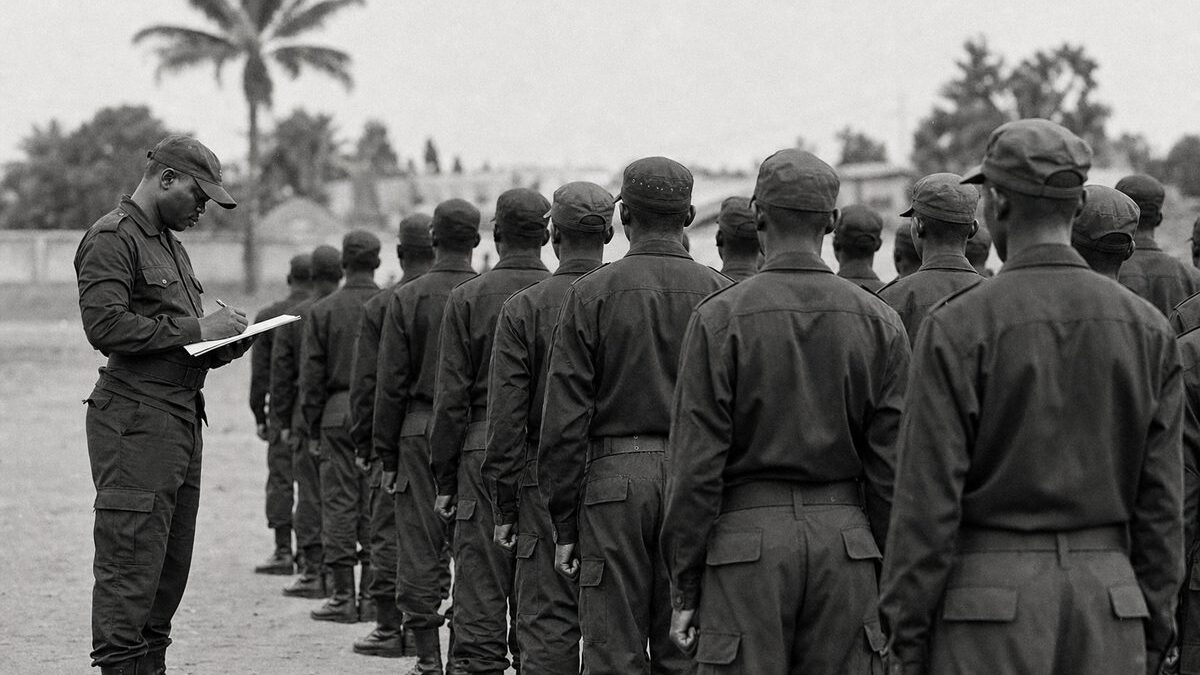
The 2002 Global and All-Inclusive Agreement, signed at Sun City, ended the Second Congo War by sharing power among the men who had fought it. The new national army, the FARDC, was stitched together from government forces and rebel movements through two parallel tracks: disarmament, demobilisation and reintegration (DDR) for fighters leaving military life, and brassage, a mixing process that disbanded former militia units, blended their soldiers into new brigades and posted them away from home areas to break old chains of loyalty.
On paper, anyone suspected of crimes against humanity was excluded from integration. In practice no administrative machinery existed to enforce that rule, and amnesty deals cut with militia leaders in Ituri in 2006 showed how negotiable it was. Field research published in 2009 found that DDR incentives perversely selected for the worst men: conditions in the army were so poor that mostly those who could only live by the gun stayed in uniform. Commanders suspected of orchestrating atrocities kept their ranks, and several were later indicted; the International Criminal Court’s DRC cases, including those against Thomas Lubanga, Germain Katanga and Bosco Ntaganda, all arose from this milieu.
The numbers told their own story. An EU-supported census in the late 2000s found roughly 160,000 names on the FARDC payroll, of which an estimated 20,000 to 30,000 were “ghosts”, non-existent soldiers whose salaries senior officers pocketed. Real soldiers, meanwhile, went unpaid and extorted the population to survive.
A police force built as an afterthought
The police fared worse. The Sun City settlement devoted a single line to law enforcement, and the Police Nationale Congolaise, created by decree in 2002, absorbed former gendarmes, civil guards, urban police, ex-militiamen and even the widows and orphans of dead officers, who inherited positions because no pension system existed. A Congolese-international review body, the GMRRR, delivered a verdict that remains one of the bleakest official assessments of any police force:
The Congolese police in its current state can in no way claim to be a pillar of the rule of law. Its capabilities have been limited since inception and it cannot alone assure the security of the citizens in the present context.
Investigators documented extortion, illegal detention, torture and arbitrary killing by police officers, and repeated cases of women raped while held illegally at police stations. Senior officers still understood their mission as protecting the state from its enemies rather than protecting citizens, a doctrinal confusion between army and police that reform programmes have struggled with ever since.
Impunity as the operating system
The thread connecting army, police and courts is impunity. Because the political settlement placed former belligerents in charge of the institutions meant to hold them accountable, human rights violations carried no consequence, and soldiers interviewed by academic researchers identified the leadership’s impunity as normalising abuse in the ranks. The consequences fell heaviest on women and girls. Sexual violence in eastern DRC reached a scale that drew global condemnation, with the UN documenting systematic rape by armed groups and state forces alike; the war’s wider human cost was estimated by the International Rescue Committee at 5.4 million excess deaths between 1998 and 2007.
Criminal networks compounded the problem. The absence of real command and control concealed webs of illegal economic activity, especially mineral extraction in the east, often run by officers in collusion with the very armed groups the army was deployed to fight. Reform that threatened those networks threatened powerful incomes, which is a large part of why domestic appetite for it stayed low.
What justice-sensitive reform means
Against this background, researchers working with the International Center for Transitional Justice argued that technical assistance alone, training, equipment and salaries, could make abusive institutions more efficient without making them less abusive. Their alternative, a justice-sensitive approach to security system reform, rests on three pillars.
- Integrity. Build accountability into the institution: internal discipline, external oversight, and the removal of human rights abusers so that no one is demonstrably above the law.
- Legitimacy. Rebuild public trust through fair treatment, and through symbolic measures such as apologies, memorials and new insignia that mark a break with the abusive past.
- Empowerment. Turn subjects of state oppression into rights-bearing citizens, through public information, citizen surveys of security needs and civil society monitoring of the security forces.
The signature tool is vetting: screening serving personnel and candidates against their human rights records, with dismissal as the sanction. Done properly, vetting is not a one-off purge but the start of permanent disciplinary and oversight machinery. It also has a hard prerequisite that the DRC has repeatedly failed to meet: knowing who is actually in the institution. A census must close the institution’s boundaries, with formal identification for every member, before screening can mean anything. The chaotic, repeatedly recycled integration of armed groups into the FARDC, from the CNDP in 2009 to later waves, kept reopening those boundaries and rebuilding patronage networks inside the army.
Europe’s long engagement, and its limits
The EU invested heavily in security sector reform in the DRC. EUSEC RD Congo, launched in 2005, advised the defence ministry and ran a chain-of-payments project that separated salary distribution from the officers who had been stealing it. EUPOL RD Congo worked on police reform alongside a UK programme worth £40 million for 2008 to 2010, and the European Development Fund put over €560 million on the table for 2008 to 2013. MONUC, the UN mission that became MONUSCO in 2010, grew into the world’s largest peacekeeping operation with a mandate that included support to army reform.
The record of all this effort is thin, and the reasons documented at the time still apply. The Congolese government preferred bilateral deals it could control, and reacted sharply to anything resembling conditionality on security or human rights. European member states planned bilaterally from their capitals rather than jointly. Donors gravitated to visible, short-term training projects and avoided the unglamorous, expensive work of logistics and oversight. Belgium’s experience became a cautionary tale: a Belgian-trained integrated brigade, human rights modules included, later went on a rampage of rape and pillage in the Kivus because no one funded follow-up monitoring. The EU missions wound down in the mid-2010s with the deeper political economy of the security system intact.
Why it still matters
Every subsequent crisis has traced back to the unreformed core. The M23 rebellion of 2012 began as a mutiny of former CNDP officers integrated into the army under yet another unscrutinised deal; the International Crisis Group’s DRC analysis has tracked how each cycle of integration without accountability seeded the next rebellion, up to and including the M23 offensive that took Goma and Bukavu in 2025. The full regional dimension of that story is examined in this journal’s analysis of the conflict in eastern DRC and its close study of North and South Kivu.
The lesson generalises beyond the Congo. Security institutions built by power-sharing among perpetrators will reproduce abuse unless accountability is engineered into them, a theme this journal explores comparatively in its work on transitional justice and security reform, on EU support to demobilisation and on public security and justice provision. In the DRC, prosecutions of a handful of commanders, national trials and ICC convictions included, have punctured impunity without breaking it. Until vetting, honest payrolls and civilian oversight reach the FARDC and the police as institutions, security sector reform in the DRC will remain a project permanently filed under unfinished.
Frequently asked questions
What is security sector reform in the DRC?
Security sector reform (SSR) in the DRC is the effort, underway since the 2002 peace agreement, to turn the national army (FARDC), police (PNC) and justice institutions into effective, accountable services under civilian oversight. It has included army integration, censuses, salary reform, police restructuring and training, supported mainly by the UN, the EU and bilateral donors.
What was brassage?
Brassage was the integration process used to build the FARDC after 2003. Former militia units were disbanded, their fighters mixed into new brigades with soldiers of other backgrounds, and deployed away from their home areas to break old command loyalties. In practice unified command was never achieved, and later deals let armed groups enter the army as intact blocs.
Why is the Congolese army considered part of the security problem?
Because it was assembled from former belligerents without screening, kept abusive commanders in senior posts, and left soldiers unpaid, poorly trained and dependent on extortion. Documented FARDC abuses include looting, systematic rape and collusion with armed groups in illegal mining, which is why researchers described the security system itself as a threat to the population.
What are “ghost soldiers”?
Ghost soldiers are non-existent names on the military payroll. An EU-supported census found roughly 160,000 names on the FARDC payroll in the late 2000s, of which an estimated 20,000 to 30,000 were ghosts whose salaries were pocketed by senior officers, while real soldiers often went unpaid.
What does “justice-sensitive” SSR mean?
It is an approach that adds accountability for past and ongoing abuses to conventional capacity-building. Its three pillars are institutional integrity (discipline, oversight, removal of abusers), legitimacy (rebuilding public trust) and citizen empowerment. The aim is to prevent technical assistance from simply making abusive institutions more efficient.
What is vetting in security sector reform?
Vetting means screening serving personnel or recruits against their records, particularly on human rights, and excluding those whose conduct disqualifies them from public service. The maximum sanction is loss of employment rather than prison, so it complements rather than replaces criminal prosecution. It requires a reliable census and formal identification of every member of the institution.
What did the EU actually do for SSR in the DRC?
The EU ran two missions from 2005: EUSEC RD Congo, advising on defence reform and building a chain of payments that stopped officers stealing salaries, and EUPOL RD Congo, supporting police reform. The European Development Fund allocated over €560 million for 2008 to 2013, and the UK committed £40 million to police reform for 2008 to 2010.
Why did internationally supported reform achieve so little?
The government resisted anything touching sovereignty or elite incomes, donors fragmented their efforts bilaterally and favoured short-term training over long-term oversight, and no political constituency existed for removing abusers whose networks profited from the status quo. Reform addressed capacity while the real problem was accountability.
How does impunity in the security forces affect women?
Directly and severely. Police and soldiers have been documented perpetrators of sexual violence, including rape of women held illegally in police stations. Impunity also silences victims: where women fear reporting rape to officers who may abuse them again, crimes go unreported and uninvestigated regardless of police technical capacity.
What is the connection between SSR failure and the M23 rebellions?
The M23 movement was founded in 2012 by former CNDP officers who had been integrated into the army in 2009 without vetting and then mutinied. Each cycle of unscrutinised integration preserved parallel chains of command inside the FARDC, and the pattern of rebellion, reintegration and renewed rebellion continued into the M23 offensive that seized Goma in 2025.
Has anyone been prosecuted for atrocities in the DRC?
Some commanders have. The International Criminal Court convicted Thomas Lubanga, Germain Katanga and Bosco Ntaganda for crimes committed in eastern DRC, and Congolese military courts have tried soldiers, including for mass rape. Prosecutions remain exceptional relative to the scale of documented crimes, which is why impunity is still described as systemic.
Is MONUSCO involved in security sector reform?
Yes. MONUSCO (formerly MONUC), deployed since 1999, has supported army operations, protection of civilians and reform processes, and grew into the world’s largest peacekeeping operation. Its long-negotiated withdrawal, begun in the mid-2020s, has raised the stakes for the Congolese forces meant to replace it.
Filed under Great Lakes