Public Security and Justice After Conflict
 AI
AIPublic security is the first thing citizens ask of a state after war, and often the last thing they get. Research conducted between 2008 and 2010 across conflict-affected countries including Afghanistan, Burundi, the Democratic Republic of Congo, Haiti and Nepal, by a security research cluster coordinated by Saferworld with partners including International Alert and the International Center for Transitional Justice, treated security provision and access to justice as essential public services, a basic entitlement rather than a privilege of the powerful. That framing sounds obvious. In post-conflict practice it is anything but.
After violent conflict, norms on the use of force change for the worse. Weapons proliferate. State justice and security agencies emerge from war weak, corrupt or openly predatory, threatened by rebel and criminal elements and sometimes indistinguishable from them. The task of restoring public security and justice after conflict is therefore not a return to a functioning baseline; it usually means building institutions that never served the public in the first place.
Security and justice as public services
The research placed security and justice among the fundamental building blocks of good governance: preconditions for respect for human rights, the rule of law and any sustained social and economic development. Development, in turn, is a condition for lasting security. The two feed each other, which is why donors address them through overlapping programmes of disarmament, demobilisation and reintegration, small-arms control and reform of the police, military and judiciary.
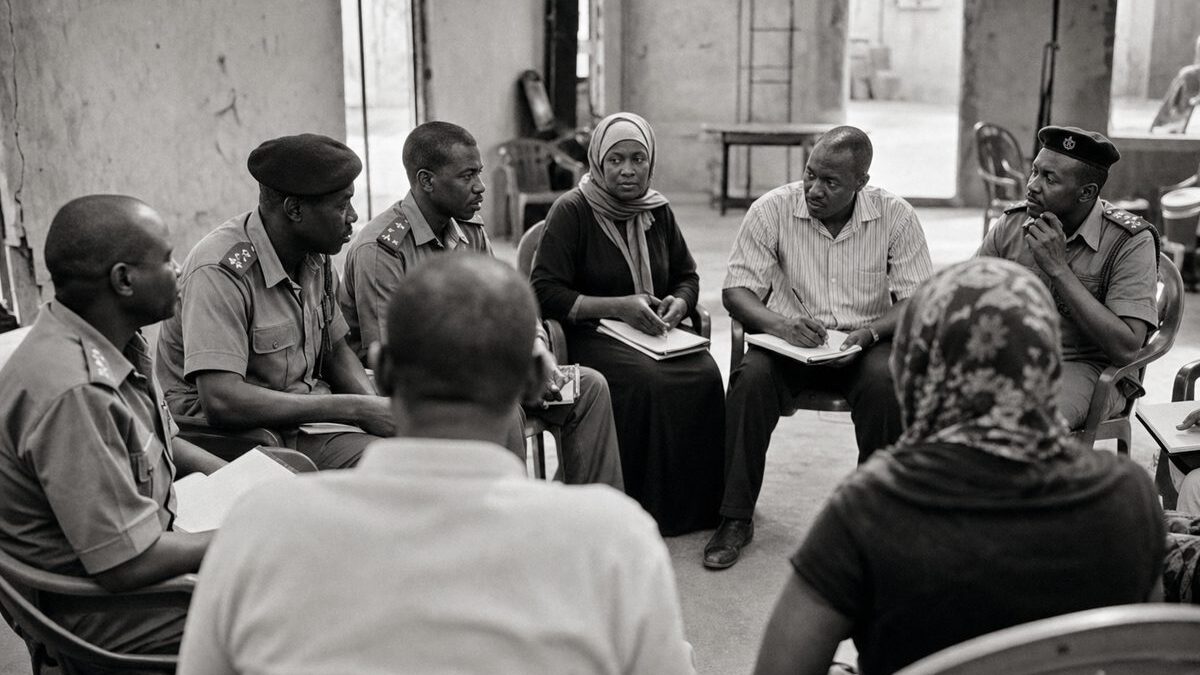
What distinguishes a public-service view of security is the question it starts from. Instead of asking what the army or the interior ministry needs, it asks what makes men, women and children in a particular district feel unsafe, and who currently protects them. The answers rarely match national security planning. Fieldwork in Liberia and elsewhere found that people’s immediate concerns centre on safety at home and in the community, on freedom of movement, on everyday crime and on violence within households, not on the border threats that dominate defence budgets. The companion research on inclusive security institutions found that insecurity is experienced differently according to gender, age, ethnicity and geography, and that marginalised groups often cannot access services, articulate their concerns or feel represented by reforms run from the capital. How people themselves define those needs is the subject of the journal’s overview of responding to people’s security needs.
Security provision and access to justice are essential public services which should be recognised as a basic entitlement, the synthesis concluded. They are fundamental building blocks to achieving good governance.
The justice gap after conflict
A finding common to nearly all the country studies is that donor programmes target the visible sub-sectors, policing and the military, far more readily than the justice sector, and the corrections system least of all. The researchers called this a prima facie gap. Tackling impunity and restoring the rule of law are what reduce the likelihood of renewed violence and curb abuse of the population by security agents; a better-equipped police force reporting to an untouched, corrupt judiciary simply processes citizens into a broken system.
Delivering justice after conflict also demands safeguards that standard judicial reform overlooks. Where the domestic judicial system has essentially failed, the DRC case study listed what serious prosecutions actually require: witness protection, legal assistance for victims, practical support such as childcare so that women can participate in trials, court monitors to check that international standards are met, and follow-up to make sure judgments, from reparation payments to prison sentences, are carried out. A conviction that is never enforced teaches the population a precise lesson about impunity. The wider argument that reform of abusive institutions is itself a form of justice is developed in the journal’s article on transitional justice and security system reform, and the Congolese experience is examined in the case study of security system reform in the DRC.
Distance compounds the gap. Police stations and courts tend to sit in district or regional capitals, sometimes more than a day’s journey from the communities where crimes occur. Much of the support that survivors of gender-based violence receive is provided informally by local organisations that formal reform programmes never reach. Maintaining a plurality of justice provision, including customary mechanisms, while ensuring informal systems do not perpetuate discrimination, remains one of the hardest balances in the field; guidance from bodies such as the UN Development Programme and DCAF, the Geneva Centre for Security Sector Governance, has grown out of exactly these dilemmas.
What the country studies showed
The case research supplied concrete illustrations of how public security efforts succeed or stall.
- Nepal. Donors long viewed public security through a state-building lens, at times supplying arms and equipment to forces with persistent records of human rights violations. After the conflict, priorities centred on reintroducing the Nepal Police into former conflict areas and negotiating the integration of former Maoist fighters into the army. Researchers argued that how this was done mattered as much as whether: public consultation and gestures of reconciliation were needed for communities to accept the police back at all.
- Burundi. Donors defined security needs around state institutions and largely failed to involve wider society, even though community-level programmes, including police-community dialogue supported through the UN Peacebuilding Fund, showed that consultation visibly improved relations between citizens and the security services.
- Haiti. A Commission urban planning and regeneration project that built consultation with local people into its design responded to needs on the ground and stood out as a success among the cases.
- Ukraine. The EU Border Assistance Mission initially skipped local consultation, then partly recovered through a public outreach campaign; in areas the outreach covered, awareness and appreciation of the project ran notably higher, and the assumption that anti-smuggling work would be unpopular proved wrong.
The pattern across cases is consistent. Where communities were meaningfully involved, programmes were seen as relevant and legitimate by the people they were meant to benefit. Where they were not, reforms were resented, ignored or rejected, as happened with several internationally designed reforms in Afghanistan.
Politics decides what programmes can do
The synthesis closed on a warning that has outlived its publication date. Security-building interventions touch the machinery through which a state exercises its monopoly on the legitimate use of force, which makes them politically sensitive by definition. Efforts that succeeded were grounded in national political processes and backed by sustained diplomatic dialogue between donors and recipient governments. Efforts that failed had usually invested too much faith in technical fixes, training, equipment, infrastructure, where the political conditions for reform were absent. In the DRC, the government’s lack of commitment was itself the binding constraint; no amount of programming could substitute for it.
For citizens, the measure of success is simple and unforgiving: whether day-to-day life becomes safer and whether wrongs can be taken somewhere and answered. Institutions that pass that test accumulate the public confidence on which everything else in peacebuilding rests. Related coverage can be found across the journal’s security and justice section, including the analysis of local peacebuilding in Nepal.
Frequently asked questions
What does public security mean in a post-conflict context?
It means the safety of ordinary people in their homes, streets and communities, provided as a public service by accountable institutions. After conflict it covers protection from crime and armed violence, freedom of movement, and security forces that serve rather than prey on the population.
Why is justice after conflict so often neglected?
Donor programmes gravitate to visible, quantifiable work with police and the military, while courts and prisons are harder, slower and politically more sensitive to reform. The 2009 research called this a clear gap, since tackling impunity is what actually reduces the risk of renewed violence.
How are security and development connected?
They are mutually dependent. Security and access to justice are preconditions for social and economic development, and development in turn sustains security. This is why security provision is treated as a core governance function rather than a purely military matter.
What safeguards do prosecutions need where the justice system has failed?
The DRC research listed witness protection, legal assistance, practical support such as childcare so women can take part in trials, court monitors to uphold international standards, and follow-up to ensure that judgments, including reparations and prison sentences, are actually enforced.
Why does community consultation matter for public security programmes?
Because programmes designed without local input routinely miss the threats people actually face and forfeit legitimacy. In Haiti and Ukraine, consultation and outreach measurably improved acceptance and results; in Burundi and Afghanistan, its absence bred rejection of reforms.
What is a people-centred approach to security?
An approach that starts from the security needs of individuals and communities rather than from state institutions. It asks who feels unsafe, why, and who currently provides protection, then designs reform so that women, men, girls and boys of all backgrounds benefit from it.
What role do informal justice systems play after conflict?
Where courts are distant, slow or distrusted, customary and community mechanisms handle most disputes and much of the support for victims. The challenge is to work with this plurality while ensuring informal systems do not entrench discrimination, particularly against women.
Which countries did the security research cover?
Case studies examined Afghanistan, Albania, Burundi, the Democratic Republic of Congo, Haiti, Nepal, Timor-Leste and Ukraine, all countries that had experienced fragility or violent conflict, alongside a mapping of EU and member-state security policies.
Why do technical fixes fail without political dialogue?
Security sector reform challenges entrenched power structures, so it advances only where national political processes support it. The research found that failed programmes had typically relied on training and equipment in contexts where the political conditions for reform did not exist.
How does gender shape public security needs?
Insecurity is experienced differently by gender: women face high levels of violence in the home and community and barriers to reporting it, while men face greater risks of gun violence and forced recruitment. Gender-based violence in particular demands joint reform of policing and justice, since one without the other leaves crimes unprosecuted.
Filed under Great Lakes